Health Education Endorsement
Mrs. Jill Jayne Pakulski Weeks
Initial Vermont Level I Educator License
Cover Letter
Resume
Praxis
SAT & ACT
Certificate of Attendance Peer Review Clinic
Transcripts:
Highlands High School
Penn State University (BS Nutritional Sciences, Minor Theater, Honors Journalism)
Teachers College Columbia University (MS Nutrition Education)
Berklee College of Music (15 Credits)
Reference Letters:
D300
Kodak Elementary School
Pennsylvania Academy of Nutrition and Dietetics
School District of Philadelphia
Texas Department of Agriculture
Ticonderoga Elementary
University of Nevada Extension
Green Mountain Community Fitness
Professional Attributes and Code of Ethics
Additional Certifications:
CPR

Part 1: The Learner and Learning
| Standard One: Learner Development | Performance Criterion (P.C.) | Evidence and Rationale |
|---|---|---|
| The teacher understands how learners grow and develop, recognizing that patterns of learning and development vary individually within and across the cognitive, linguistic, social, emotional, and physical areas, and designs and implements developmentally appropriate and challenging learning experiences. | PC 1.1 Candidates use an understanding of learning theory (in areas such as cognitive, linguistic, social emotional or physical) to design appropriate learning experiences. | 1.1a Strategies for Nutrition Education and Behavior Change — Course Materials by Contento & Koch Description: Graduate course materials from my MS in Nutrition Education at Teachers College Columbia University, including foundational readings and theoretical frameworks from Isobel Contento and Pam Koch, whose work became the textbook Nutrition Education: Linking Research, Theory, and Practice, now in its 5th edition. Rationale: My graduate training under Contento and Koch gave me a deep, theory-grounded understanding of how learners — specifically children — grow into and adopt health behaviors. I studied how Social Cognitive Theory (self-efficacy), the Theory of Reasoned Action (behavioral intention), and the Health Belief Model (perceived susceptibility) explain how individuals move through stages of behavior change across cognitive, social, and emotional dimensions. This theoretical foundation is the backbone of every learning experience I designed at Jump with Jill — I did not simply teach nutrition facts, I designed programs that met children where they were developmentally and emotionally, building their confidence and motivation to choose healthy behaviors. |
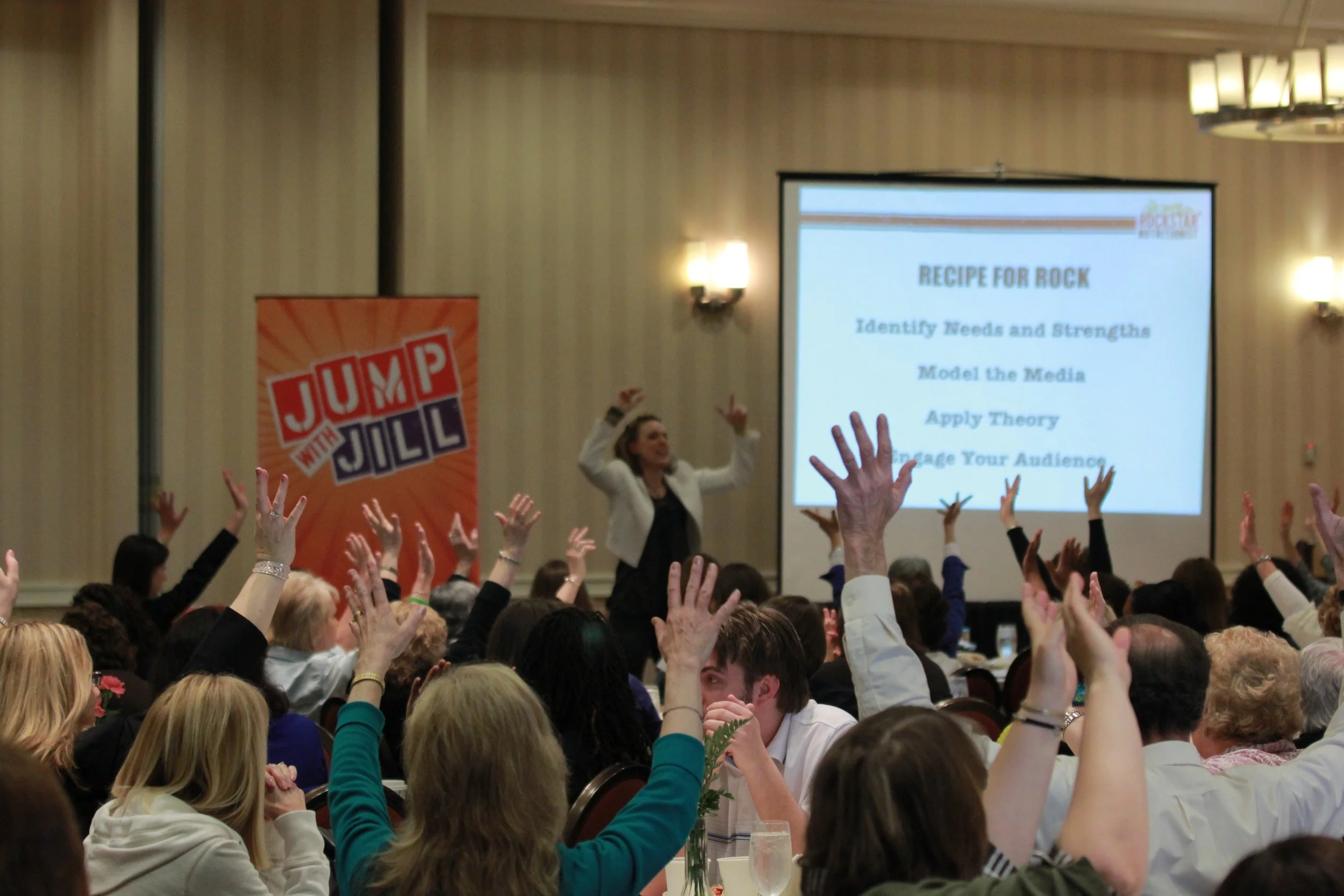
| 1.1b Nutrition Education Through Entertainment - Keynote Resource Packet by Jill Description: Conference handouts for professionals to accompany my popular keynote address Nutrition Education through Entertainment. Rationale: Using a train-the-trainer model, these conference handouts walk fellow practitioners and educators through how Jump with Jill was explicitly grounded in learning theory. By design, I delivered it in my trademark style: singing, dancing, and wearing skinny jeans. I applied Social Cognitive Theory, the Health Belief Model, and the Transtheoretical Model to design developmentally appropriate experiences. For example, I distinguish how perceived threat is framed differently for a 3rd grader versus a middle schooler and how kinesthetic, auditory, and visual modalities are layered to reach all learners. Empowering my peers to replicate this theory-based framework in their own practice is one of my lasting professional legacies. | ||
| 1.1c Nutrition Education: Linking Research, Theory, and Practice — Textbook by Contento & Koch Description: Page 19 from the 4th edition of the field’s definitive nutrition education textbook featuringJump with Jill as an example of effectively linking research, theory, and practice in a real-world nutrition education program. Rationale: Ten years into my career, my graduate professors invited me to be featured as a model of theory-based nutrition education in action. Being selected by the scholars who trained me was the utmost validation. No one had — and still has — attempted delivering nutrition education as a concert, and that innovation got their attention. But it was the rigorous theoretical framework underneath it that got me in the book. Contento and Koch recognized that the theory driving Jump with Jill was universal and teachable, applicable to any nutrition educator regardless of whether they could carry a tune. | ||
| PC 1.2 Candidates use an understanding of developmental theory (in areas such as cognitive, linguistic, social emotional or physical) to design appropriate learning experiences. | 1.2a Jill & Jam – Preschool Health Education Program Description: Preschool version of Jump with Jill — a live interactive touring show and companion CD chronicling a preschooler's full day of healthy habits in song, including nutrition, movement, hygiene, sleep, and environmental stewardship. Rationale: Preschoolers are not developmentally equipped to understand the persuasive intent of advertising — the American Psychological Association confirms this — yet 66% are already exceeding daily screen time recommendations and are being marketed to constantly. I designed Jill & Jam around that developmental reality. Rather than competing with junk food advertising, I used the same tactics — catchy hooks, repetition, bright visuals, and movement — to make healthy habits the exciting, cool, and normal thing to do. The content itself was also developmentally sequenced, following a preschooler's actual day from wake-up to bedtime, grounding abstract health concepts in the concrete, familiar routines that young learners need to make meaning. | |
| 1.2b I Will Not Be Bought – Middle School Health Education Program Description: Middle School version of Jump with Jill — an interactive, music-based media literacy program touring middle schools nationwide, addressing the influence of advertising on body image, nutrition, substance abuse, and peer pressure through a live show and online community. Rationale: Middle schoolers are not motivated by health; they are motivated by identity, belonging, and authenticity. I designed I Will Not Be Bought around that developmental reality, meeting students where they were by tapping into their music taste, their distrust of authority, and their fierce desire to be their own person. Rather than lecturing about nutrition, I taught the media literacy — pulling back the curtain on the advertising machine that was shaping their food choices without their knowledge. By anchoring nutrition education in something middle schoolers already cared deeply about, I was real in a world that was trying to sell them something fake. I designed a learning experience that was developmentally appropriate, emotionally resonant, and genuinely hard to ignore. | ||
| Standard Two: Learning Differences | Performance Criterion (P.C.) | Evidence and Rationale |
| The teacher uses understanding of individual differences and diverse cultures and communities to ensure inclusive learning environments that enable each learner to meet high standards. | PC 2.1 Candidates use an understanding of individual differences to design inclusive learning experiences. | 2.1a Excerpt from unpublished Chapter 16 of Communicating Nutrition: The Essential Guide for Food & Nutrition Professionals Description: A chapter I authored on the VARK framework, including an original graphic about how the learning modalities interact. Rationale: Designing inclusive nutrition education requires understanding that learners differ in how they receive, process, and retain information. In Chapter 16, I apply the VARK framework — Visual, Auditory, Read/Write, and Kinesthetic — to explain how health communicators can reach diverse learners by layering multiple modalities rather than relying on a single instructional approach. Kinesthetic learning in particular serves as a bridge across all other categories, activating motor pathways, embodied cognition, and emotional engagement that deepen retention and motivation. This understanding directly shaped the design of Jump with Jill, which combines original music, movement, visual performance, and behaviorally-focused lyrics that work together to create a memorable, multi-modal learning experience. |
| 2.1b Jump with Jill: The Movie! Description: Adaptation of the Jump with Jill live school assembly into a full-length filmed production, Jump with Jill: The Movie!, designed to bring the same rockin' nutrition education experience directly to students' screens. Rationale: The live Jump with Jill assembly was designed to reach learners through kinesthetic, auditory, and visual modalities simultaneously — but that format excluded students in schools who could not book the show, whether for financial reasons or geography to individual learning environment. Recognizing that inclusive learning requires meeting students where they are, I reimagined the live show as a cinematic production, rebuilding it for the screen with multiple sets, enhanced production values, and the same movement-based, multi-modal design that makes the program effective. This adaptation ensured that students who learn best in smaller classroom settings, who benefit from repeated viewing, or who simply could not access the live show were no longer left out of the learning experience. | ||
| PC 2.2 Candidates use an understanding of diverse cultures and communities to design inclusive learning experiences. | 2.2a Jump with Jill En Español Flashcards Description: A bilingual reference document developed in collaboration with a Spanish-speaking Registered Dietitian Rationale: When Jump with Jill toured in regions with large Spanish-speaking populations, I recognized that delivering the program only in English would create a barrier to full participation for many students. To design a more inclusive learning experience, I partnered with a Spanish-speaking registered dietitian to develop culturally and linguistically accurate translations of the show's core vocabulary, instructional commands, and nutrition messaging. By weaving Spanish language into the live performance — from "¡Levántense todos!" to "¡Vegetales Superpoderosos!" — I ensured that English language learners could actively participate alongside their peers, access the health content in their home language, and feel seen and included in the learning experience rather than marginalized by it. | |
| 2.2b Jump with Jill Goes Kosher Description: Documentation of adaptations made to the Jump with Jill show for a performance at Ramaz Lower School, a Modern Orthodox Jewish day school in New York City, including costume modifications, Hebrew language integration, and kosher-compliant food props and references. Rationale: Performing at Ramaz Lower School required me to deeply understand the cultural and religious practices of the Jewish community I was entering in order to design a learning experience that would feel inclusive and respectful rather than generic. I researched kosher dietary laws — including the prohibition on mixing meat and dairy, restrictions on shellfish and pork, and the requirement for kosher certification — and adapted the show's food props, snack references, and nutrition messaging accordingly. I opened the show with "Shalom" and Hebrew phrases to welcome students in their own cultural language, and I modified my costume to align with the school's modesty standards. This preparation ensured that every child in that gymnasium could see their community reflected in the health education experience rather than overlooked by it. | ||
| Standard Three: Learning Environments | Performance Criterion (P.C.) | Evidence and Rationale |
| The teacher works with others to create environments that support individual and collaborative learning, and that encourage positive social interaction, active engagement in learning, and self-motivation. | PC 3.1 Candidates design learning environments that support individual learning marked by active engagement. | 3.1a Get Me Goin' Danceable Music Video Description: A hit song about breakfast, Get Me Goin', as a danceable music video. With a cereal box as a maraca and fruit bowls as agogo bells, Jill cooks up a Latin beat with the sounds of breakfast. Joining the scene of this morning routine is Spanish-speaking Mr. Desayuno. From the cafeteria, to the classroom, to on-the-go, these two take you to all the places where you can enjoy a delicious and nutritious breakfast in style. Rationale: Get Me Goin' was designed to transform breakfast nutrition education from a passive message into an active, individually engaging experience. By setting the lesson inside a danceable Latin music video — where a cereal box becomes a maraca and fruit bowls become agogo bells — the song invites individual learners to physically engage with the content through movement, rhythm, and sing-along participation, regardless of setting. The video intentionally moves through multiple environments — cafeteria, classroom, and on-the-go — reflecting my understanding that individual learners encounter and make breakfast decisions in different contexts. By meeting students in those real-world moments through music and movement, Get Me Goin' creates an active learning experience that a student can engage with independently, repeatedly, and joyfully, making healthy breakfast habits personally meaningful rather than prescriptive. |
| 3.1b Nature’s Candy Danceable Music Video Description: The Rockstar Nutritionist channels her inner James Brown (or shall we say Janelle Monae?) to showcase the electrifying power of choosing fruit over candy. Joined by her band on piano, sax, upright bass, drums, and guitar and her featured dancers to model the moves, the song is presented in three levels to allow kids to master the moves. Rationale: Nature's Candy was intentionally designed to support individual active engagement by presenting the song and its choreography in three progressive levels, allowing each learner to enter the experience at their own level of readiness and build mastery at their own pace. Rather than presenting a single performance for passive viewing, this structure invites individual students to actively participate, practice, and advance — mirroring the principles of differentiated, mastery-based learning. The high-energy funk performance, live band, and featured dancers create an irresistible environment for movement, while the scaffolded choreography ensures that no learner is left on the sidelines — from the student taking their first steps to the one ready to perform at full intensity. Choosing fruit over candy becomes not just a health message but a personal achievement, earned through active physical engagement with the content. | ||
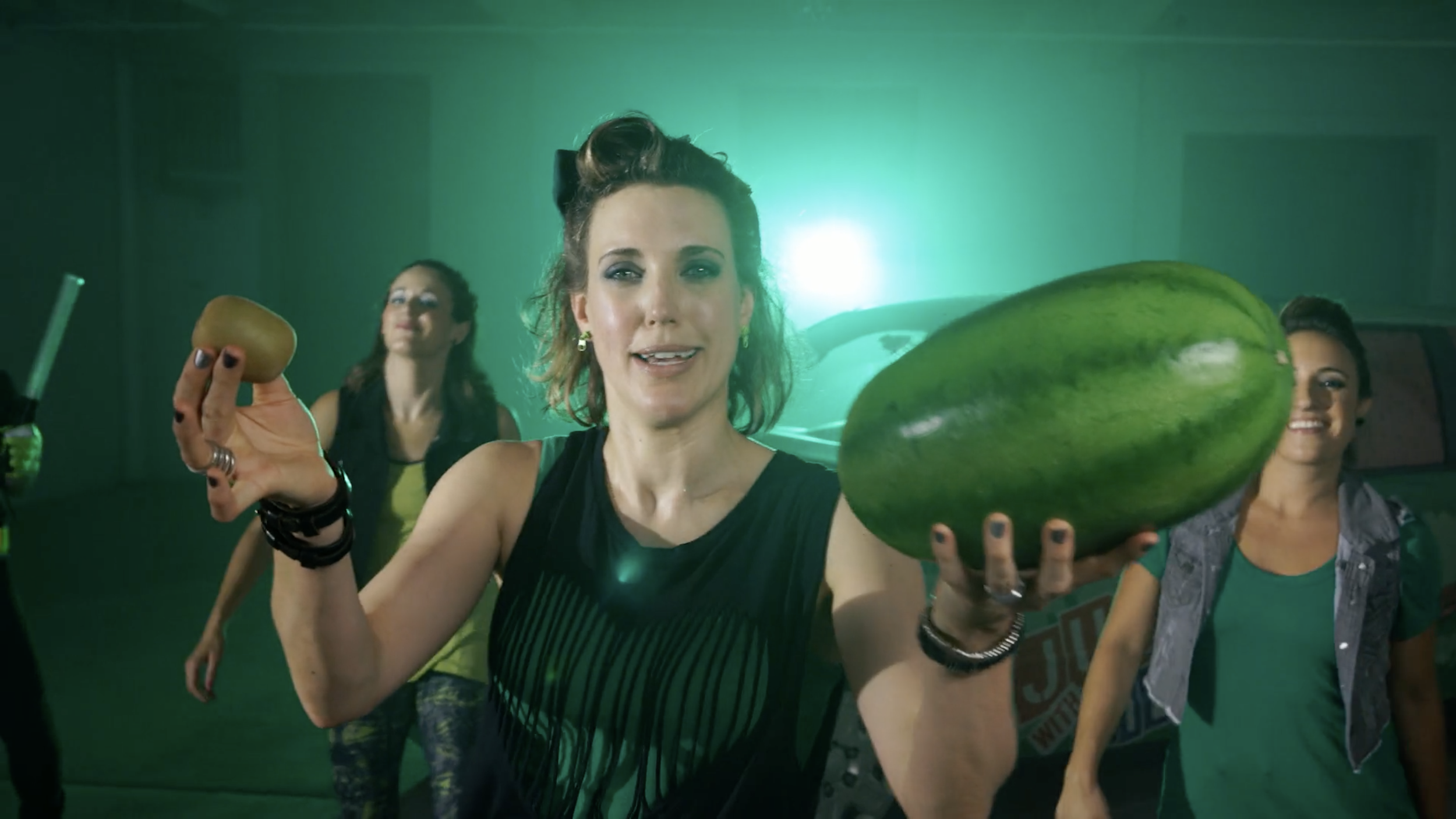
| PC 3.2 Candidates design learning environments that support collaborative learning marked by positive social interaction. | 3.2a Superpower Vegetables Danceable Music Video Description: Jill loves vegetables. They inspire her fashion, her music, and of course, her meals. Vegetables are great for your skin, hair, muscles, eyes, and bones. In this music video, jump into Jill’s virtual reality of powering your plate with superpower vegetables. Beyond the everyday world of couch cushions, clothing racks, and picky eaters, you can walk on clouds, climb over buildings, and transform into a cruciferous comrade. United against junk food we will be victorious! Rationale: Superpower Vegetables was designed to create a shared, collaborative learning experience by casting students not as individual recipients of a health message, but as a unified community with a common mission. The video's virtual reality world — where kids climb buildings, walk on clouds, and transform into cruciferous comrades — establishes a collective identity and a shared cause: together, we are victorious against junk food. This social framing is intentional. Research shows that health behavior change is more likely when it becomes a group norm rather than an individual choice, and by positioning vegetable-eating as something we do together, the video creates the conditions for positive peer influence and shared motivation. In the classroom, the call-and-response energy of the song and its ensemble cast of dancers invite students to move, cheer, and participate as a group — turning a nutrition lesson into a collective, high-energy social experience where choosing vegetables feels like joining a team. | |
| 3.2b The Bone Rap Danceable Music Video Description: The song and video bring the benefits of dairy to life in true hip hop fashion. The nightclub experience has been flipped to celebrate milk by his rapper name, Cal¢ium, and his bone building crew of cheese and yogurt -- the staff dresses as cows who serve up low fat dairy products and the VIP room is reserved for those who get down with healthy bones. Rationale: The Bone Rap was deliberately designed around a social environment — a nightclub — because nightclubs are inherently collaborative, communal spaces where belonging, identity, and shared experience drive behavior. By reimagining this setting as a celebration of calcium and bone health, the video creates a learning environment where healthy choices are socially desirable and collectively reinforced. Cal¢ium's bone-building crew of cheese and yogurt, the cow-costumed staff, and the exclusive VIP room for those who get down with healthy bones all communicate the same message: choosing dairy is something you do with your people. In the classroom, this translates to a shared viewing experience where students laugh, move, and participate together — the social energy of the video becoming the social energy of the room. By embedding the nutrition lesson inside a culture of belonging and positive peer interaction, The Bone Rap transforms what could be a solitary health directive into a joyful, communal experience that students want to be part of. |
Part 2: Content Knowledge and Instructional Practice
| Standard Four: Content Knowledge | Performance Criterion (P.C.) | Evidence and Rationale |
|---|---|---|
| The teacher understands the central concepts, tools of inquiry, and structures of the discipline(s) they teach and creates learning experiences that make the discipline accessible and meaningful for learners to assure mastery of the content. | PC 4.1 Candidates accurately communicate central concepts of the discipline. | 1 The JillPlate |
| 2 Jill Posters | ||
| PC 4.2 Candidates accurately address common misconceptions of the discipline. | 1 Listen to Your Body | |
| 2 Try New Foods | ||
| Standard Five: Application of Content | Performance Criterion (P.C.) | Evidence and Rationale |
| The teacher understands how to connect concepts and use differing perspectives to engage learners in critical thinking, creativity, and collaborative problem solving related to authentic local and global issues. | PC 5.1 Candidates engage learners in applying perspectives from varied disciplines in authentic contexts (such as local and global issues). | 5.1a https://www.jumpwithjill.com/watermelon-workouts |
| 5.1b nutrition action news | ||
| PC 5.2 Candidates integrate cross-disciplinary skills (such as critical thinking, creativity, and collaborative problem solving) to help learners demonstrate their learning in unique ways. | 5.2a Evidence: Jill Live! — High School Health Education Program (2015) Description: The high school version of Jump with Jill — a live taping of a professional talk show performed in the school auditorium, featuring a production crew, musical guest, and celebrity interviews on nutrition, with students as the live studio audience. Rationale: High schoolers are not going to sit still for a health assembly — but they will behave impeccably on a television set. Jill Live! was designed around that developmental reality. By transforming the auditorium into a working production set with cameras, a branded backdrop, velvet furniture, and real guests, the behavioral expectations were built into the format itself. "Quiet on set" is not a rule imposed by a teacher — it is simply what you do when the cameras are rolling. The talk show format also spoke directly to where high schoolers are developmentally: they are forming adult identities and respond to content that treats them as sophisticated, capable, and grown. By glamorizing healthy habits through the lens of professional athletes, dancers, and musicians, Jill Live! made nutrition relevant to the lives they were already imagining for themselves. | |
| 5.2b Montage of others doing BOTB/NC? can’t remember | ||
| Standard Six: Assessment | Performance Criterion (P.C.) | Evidence and Rationale |
| The teacher understands and uses multiple methods of assessment to engage learners in their own growth, to monitor learner progress, and to guide the teacher’s and learner’s decision making. | PC 6.1 Candidates plan and implement multiple methods of assessment over time and use the results to inform their instructional practice. | 1 pandemic portal |
| 2Use of the tools in the school (see TDA research) | ||
| PC 6.2 Candidates analyze an individual student’s work products over time, using multiple means of assessment, in order to adjust instruction for that student. | 1 studying student work about the show and making changes to it (what characters wear, props and set over time) | |
| 2 lessons for christoper | ||
| Standard Seven: Planning for Instruction | Performance Criterion (P.C.) | Evidence and Rationale |
| The teacher plans instruction that supports every student in meeting rigorous learning goals by drawing upon knowledge of content areas, curriculum, cross-disciplinary skills, and pedagogy, as well as knowledge of learners and the community context. | PC 7.1 Candidates plan instruction by drawing upon knowledge of content areas to meet rigorous learning goals. | 1 Rock Your Taste Buds (unit study with 5 lessons) |
| RYTB revisions | ||
| 2 Swim lessons for babies | ||
| PC 7.2 Candidates plan instruction by drawing upon knowledge of learners to meet rigorous learning goals. | 1 camp fresh | |
| 2 https://www.jumpwithjill.com/watch/film-festival | ||
| Standard Eight: Instructional Strategies | Performance Criterion (P.C.) | Evidence and Rationale |
| The teacher understands and uses a variety of instructional strategies to encourage learners to develop deep understanding of content areas and their connections, and to build skills to apply knowledge in meaningful ways. | PC 8.1 Candidates use a variety of instructional strategies to make the discipline accessible for diverse learners. | 2 videos of the show: live show segments (this is your 12-15 min video) |
| sweet beat | ||
| 3 workbooks in spanish | ||
| PC 8.2 Candidates use a variety of instructional strategies to encourage learners to build skills to apply knowledge in meaningful ways. | 1 water | |
| 2 workbooks with CCSS |
Part 3: Professional Responsibiltiy
| Standard Nine: Professional Learning and Ethical Practice | Performance Criterion (P.C.) | Evidence and Rationale |
|---|---|---|
| The teacher engages in ongoing professional learning and uses evidence to continually evaluate {their} practice, particularly the effects of {their}choices and actions on others (learners, families, other professionals, and the community), and adapts practice to meet the needs of each learner. | PC 9.1 Candidates are prepared for self-directed, continuous professional learning. | 9.1a Water Safety Instructor, American Red Cross (2025-2027) Description: WSIs are highly trained aquatics professionals that teach swim lessons, water safety, and basic rescue techniques to people of all ages and abilities. The certification requires passing swim tests, attending classes, and completing teaching assignments. Rationale: My pursuit of all things health and wellness began with my first job as a teenager – a lifeguard and swim teacher. While the lifeguard part was formal through the Red Cross, I didn’t have a certification for teaching swim lessons. I am passionate about teaching kids to learn to swim; I consider it a life skill to be safe around the water and share the benefits of swimming for fitness. I recently became a Water Safety Instructor (WSI) to deliberately step into a teaching role at Green Mountain Community Fitness in Berlin, VT. I joined a very dedicated team of educators there, many of whom are also professional educators in the classroom by day! They are the ones that encouraged me to pursue my teaching license through this alternative track, so yet again, swimming has come full circle in my life. |
| 9.1b Berklee College of Music, Certificate in Music Production – Herbie Hancock Celebrity Scholarship Recipient (2022–present) Description: Certificate program at the world's premier music college, pursued to deepen music production skills in music theory, advanced software, and sound design. Rationale: After releasing nine studio albums of music, I wanted to learn more of the software skills of a sound engineer so I could take on more aspects of production myself. The gaps I knew I needed to fill were related to music theory, advanced software DAWs like Pro Tools and in Logic, and gaining a deeper understanding of how sounds come together to create depth. Pursuing a music degree later in life as a working parent has its challenges, but my hard work paid off when Berklee awarded me a Celebrity Scholarship after just a few semesters. I do believe I am their first Rockstar Nutritionist®. I have grown so much as a musician and it’s allowing me to explore new sounds and textures that I will undoubtedly integrate into my future health curriculum. Moreover, I think it’s really important to reverse your role from educator to student to revisit how arduous learning something new can be. | ||
| PC 9.2 Candidates are prepared to practice in a legal and ethical manner. (Peer Review Required Evidence) | 9.2a Registered Dietitian Nutritionist Credential, Commission on Dietetic Registration (2022-2027) Description: National dietetic registration credential issued by the Commission on Dietetic Registration, the credentialing agency for the Academy of Nutrition and Dietetics, requiring completion of an accredited dietetic program, supervised practice, and a national examination. Rationale: Maintaining my RDN credential requires completing 75 hours of continuing professional education every five years, including dedicated hours in ethics and health equity each recertification cycle. In addition, the Commission on Dietetic Registration holds practitioners to a Code of Ethics that governs our conduct with the people we serve, our colleagues, and the public. My credential has been valid since earning it in 2007 and it is my professional backbone. | |
| 9.2b State of Vermont Dietetic License (2026-2028) Description: State-level dietetic license issued by the Vermont Secretary of State, held in addition to my national RDN credential, requiring documentation of 30 hours of continuing professional education on a two-year cycle. Rationale: Not every state requires dietitians to hold a state license, and not every RD pursues one even when it is available. I do. Holding this license ensures I am practicing legally in the state where I live and teach, meeting all legal requirements set by the Vermont Secretary of State. The additional paperwork, continuing education documentation, and fees are worth it to me because the people I serve deserve to be able to verify my credentials at the state level where I practice. Holding both national and state credentials is my standard of professional accountability. | ||
| Standard Ten: Leadership and Collaboration | Performance Criterion (P.C.) | Evidence and Rationale |
| The teacher seeks appropriate leadership roles and opportunities to take responsibility for student learning, to collaborate with learners, families, colleagues, other school professionals, and community members to ensure learner growth, and to advance the profession. | PC 10.1 Candidates are prepared to collaborate with stakeholders (such as learners, families, colleagues, other school professionals, or community members) to ensure student learning. | 10.1.a Guest Teaching Health & PE, Union Elementary School (2024) Description: Volunteered to guest teach an interactive lesson on vegetables and bone health across PE classes over two days, in collaboration with the school's Health & PE teacher. Rationale: While serving on the PTA or school board can have a meaningful impact on the educational community, I think it's important to give where your skills lie. I was thrilled to be tapped by the Health & PE teacher at my kids' school to support their nutrition unit. I got to bring both of my kids on stage for the volunteer sections. Bringing nutrition to life as a member of the community made it extra powerful. Because at Union Elementary, I'm better known as Lydia and Valerie’s mom than as the nutrition celebrity of Jump with Jill. Two years later, kids still stop me at the grocery store and say "You did that nutrition thing at my school!" |
| 10.1b Active Member, Vermont Academy of Nutrition and Dietetics (2024-present) Description: Active member attending quarterly meetings for continuing education, peer networking, and professional advocacy, including lobbying at the Vermont State House for the Dietitian Licensure Compact (H.296). Rationale: Since moving to Vermont, I have thrown myself into the state's dietetic community through VAND. I attend every event they put on — from sessions on microplastics in the food supply and food insecurity to a tour of Beta Technologies to learn how they fuel their staff. I have spoken at the State House to advocate for the Vermont Dietitian Licensure Compact, meeting with senators and representatives on the House Committee on Health Care. Advocating for legislation that protects the public and expands access to qualified nutrition professionals is something I had always been curious about but never had the chance to pursue — until I found myself living in a state capitol. While I don’t hold any office in VAND, my peers work extra hard to make events meaningful for us and they know they can count on me to be a smiling participant and represent our organization proudly. | ||
| PC 10.2 Candidates are prepared to advance the profession through advocacy, leadership and/or action research. | 10.2a Incorporation of Edutainment Into Intention & Evaluation: The Jump with Jill Program (2019) Description: In the nutrition profession, publishing in a peer-reviewed journal is the gold standard for proving that your theory works. This study takes all that talk from Part 1 of this portfolio and puts it through the rigor of academic peer review. Rationale: This is the first of many studies documenting the efficacy of Jump with Jill. The songs and flashy colors can make the ivory tower nervous. So before claiming the program changes behavior, I needed to prove we could reliably measure what was happening in a room full of third graders. The publishing strategy was deliberate: establishing the methodology. This study demonstrated that kids could be honest about their opinions even when standing in a group in front of their peers and that an emoji-based, interactive survey process was a legitimate research tool, not just a fun gimmick. I'm proud of it because it contributed something new to the field: a child-appropriate evaluation strategy that the profession can replicate. | |
| 10.2b Wellness Plan Advocate Description: In a video series called Backstage Pass, Jump with Jill went behind the scenes of our clients' wellness strategies and used our platform to promote their work to their communities. Rationale: We didn't just come to town to put on a one-time show. We were the mouthpiece for the wellness strategy for the organization that brought us in. Hospitals, dairy farmers, school districts, and departments of agriculture all scraped together enough funds to make our program happen - so we unified our efforts by singing their praises and putting it all over the internet. Backstage Pass was how we made that visible: a video series that documented the people and programs behind the mission and shared them with a wider audience. Advocating for the wellness work of our partners turned isolated wellness efforts into a coordinated movement. |

Health Education Competencies
| Item | Requirement/Competency | Evidence & Description | Rationale |
|---|---|---|---|
| In order to qualify for this endorsement, the candidate shall demonstrate the following: 2. Knowledge Standards: | |||
| KS 2.1 | Demonstrates knowledge of health and health education concepts and skills delineated in current national professional standards, in SHAPE America – National Standards for Initial Health Education Teacher Education (2018) and in National Health Education Standards, Center of Disease Control (CDC) Health Education Curriculum Analysis Tool (HECAT) and National Sexuality Education Standards including: | Evidence: Jump with Jill K-2 2.1a Activity Book 2.1b Teacher Guide Description: A student activity book and accompanying teacher guide developed to extend the Jump with Jill live assembly into the classroom. Every activity is explicitly mapped to Common Core State Standards across ELA and math, integrating health education concepts including nutrition, physical activity, hydration, and consumer health literacy. | The teacher guide demonstrates that my health education content was intentionally designed to meet national academic standards. I count watermelon slices instead of pizza slices, embed nutrition concepts in reading comprehension and math activities, and align each lesson to specific CCSS benchmarks to make health education a cross-curricular discipline connected to the broader standards framework that governs K-12 instruction. |
| KS 2.2 | Process for implementing teaching skills-based Health Education | 2.2a Honing the Message Worksheet Description: This page from my keynote conference handout literally spells out my process for developing a skills-based health education program. | My recipe for making a health message sing is to identify the needs and strengths of both the presenter and needs of the audience, assess preferred teaching and learning styles, then develop a compelling lesson that applies behavioral theory, models mass media strategies, and engages learners directly. This worksheet shows that process in action — from needs assessment and barrier identification through behavioral focus and a compelling delivery. It is skills-based health education, documented step by step. |
| 2.2b Workshop for adults SNAP | |||
| KS 2.3 | Teaching Health Skills (Interpersonal communication, media literacy, advocacy, analyzing influences, decision-making, goal-setting, and accessing health information, products, and services)) | Music of the Jump with Jill program Description: Music-based health education program Evidence: 2.3a Lyric video series https://youtube.com/playlist?list=PLUE0faBef-IHU6FGihiAcrUR0w_5z_i3x&si=tjF8mE0GiCL0Sz1e 2.3b Recordings of songs https://www.jumpwithjill.com/listen | Rationale: Jump with Jill brings health skills to life through the power of group singing — making the healthy thing the cool thing. Each song targets a specific health skill from the national framework. "Special Glasses" builds media literacy by teaching kids to look past cartoon mascots hawking junk food. "Superpower Vegetables" drives decision-making and goal-setting by asking kids to commit to trying a new vegetable that week. The show closes with an advocacy prompt — take what you learned and share it with someone at home today. Interpersonal communication, analyzing influences, and accessing health information are woven throughout. |
| KS 2.4 | Human development, including the typical progression of early childhood through early adolescent development (for PK-8) and/or early adolescent through adult growth and development (for 5-12), and age appropriate indicators of intellectual, physical, social and emotional health for each stage of development | Adapting the same message for elementary to middle school Description: Compare the same message communicated very differently in Nature’s Candy to the Sweet Beat 2.4a Nature’s Candy https://youtu.be/vQ7QLj329oY?si=mWVp4QSjAvzu1ewZ 2.5b The Sweet Beat https://youtu.be/vQ7QLj329oY?si=U3i-o5dXNQw1dIVu | Rationale: Fruit is a great snack — naturally sweet and full of nutrition. For an elementary audience, I deliver this message through "Nature's Candy," a gentle, melodic song that makes the concept accessible and fun for younger learners still building foundational health knowledge. For a middle school audience, the same concept becomes "The Sweet Beat," where kids contribute their own favorite fruits and rap them back — a format that honors their growing need for autonomy, peer connection, and creative expression. Same message, same nutrition content, completely different developmental approach. |
| KS 2.5 | Human body structure and functioning | Evidence: Penn State Coursework Physiology, Biology, Microbiology, Description: | Rationale: Nutritional science is heavy on biology, chemistry, anatomy, body processes, and nutrient metabolism. I had to memorize and be tested on complex nutrient metabolism cycles. While these are not things I use in my daily teaching, they gave me a deep understanding of how the body works — a foundation that informs every health education decision I make. |
| TC coursework Nutrition Metabolism I & II | |||
| KS 2.6 | Personal health (mental, physical, social intellectual, and the value of annual well care visits and healthful stress maintenance skills) | 2.6a Tooth Brushing Song Description: Helath and personal hygiene need positive affirmations to help these behavior occur regularly. https://youtu.be/BU_kI5xAask | Rationale: Personal health is not just knowing what's good for you — it's building the rituals that make healthy behavior habit. The Tooth Brushing Song exists because health and hygiene need positive reinforcement to become routine. Teaching kids that caring for their body is an act of self-respect, not a chore, is the foundation of lifelong health maintenance. |
| 2.6b | |||
| KS 2.7 | Nutrition (basic nutrition concepts, nutrient needs, dietary guidelines for Americans, and common nutritional problems of children and adults, including disordered eating) | 2.7a Penn State Nutrition Major – Metabolism I & II, Nutr Life Cycle, Advanced Nutrition, Nutritional Epidemiology Description: I attended Pennsylvania State University, a land-grant university founded as an agricultural school, where nutrition courses were designed as rigorous weed-out classes. I remained standing, graduated with the highest GPA in the College of Health and Human Development, and got into a prestigious combined MS/RD program at Teachers College Columbia University. | Rationale: Nutritional scientists are hard scientists, clinicians, chefs, and educators. We are part of our community and we are here to help people see healthy food as medicine. My coursework spans nutrient metabolism, clinical nutrition, community nutrition, epidemiology, and food behavior — the full breadth of what a health educator needs to teach nutrition accurately and confidently. |
| 2.7b Teachers College Nutrition Major – Food Nutrition and Behavior, Advanced Nutrition I, Clinical Nutrition, Community Nutrition Description: TC was a private school and helped me see the flaws in the land-grant education model, which funded by massive commercial agriculture juggernauts. The specialty I pursued while at TC was nutrition education under some of the field’s leaders, Pam Koch & Isobel Contento, with a very ecological nutrition bend for sustainable food systems with Joan Gussow. It is from these women that I developed the framework for Jump with Jill. | |||
| KS 2.8. | Physical activity (the health benefits of physical activity, research on physical activity and academic performance, factors that influence participation in physical activity, and strategies for collaborating with physical education colleagues to promote physical activity) | Evidence: Beat of the Body Danceable Music Video Description: "The Beat of the Body," features the transformative power of physical activity by flipping a typical 5th grade classroom into a dance party. https://www.youtube.com/watch?v=wZqlH5Uh2hI | Rationale: Understanding the research on physical activity and academic performance informed my approach to physical activity. Kids are encouraged to compose the beats of their body using the sounds of the body. Your heart, lungs, and muscles all have to be strong, because when you’re exercising, your body makes a song. So get those rhythms pumping every sort of way, so you can be your strongest each and every day. |
| KS 2.9 | Disease (etiology of diseases, including their origins, progression, diagnosis, treatment, and prevention, [e.g. immunizations] HIV/AIDS and other sexually transmitted infections) | 2.9a Penn State: Nutr Aspects of Disease, Diet in Disease, Nutritional Epidemiology Description: Understanding the constellation of symptoms and behaviors that cause and prevent disease — at both the individual and population level — is foundational to everything I teach about food choice. | Rationale: A dietitian's training is deeply rooted in disease etiology. One of the biggest areas of emphasis in my education and practice is the connection between obesity and associated disease states including diabetes and heart disease. |
| 2.9b TC: Nutritional Epidemiology | |||
| KS 2.10 | Intentional and unintentional injury prevention (safety issues and violence prevention, including bullying harassment, sexual abuse, and physical and mental/emotional trauma) | 2.10a Mandated reporter Description: After the Jerry Sandusky trials at Penn State, all licensed health professionals had to take child aubse prevention training each two year recertification process. | Rationale: Power can make even seemingly nice people into creeps. Teaching kids how to establish healthy relationships, tell someone they trust, and |
| 2.10b | |||
| KS 2.11 | Alcohol, tobacco, marijuana, and other drugs (physiological, psychological, and sociological effects of substance use and abuse on the individual, family, and society; legal issues; and curriculum and teaching strategies for effective substance abuse prevention) | 2.11a Penn State: Community Nutrition coursework | |
| 2.11b Penn State Health Behavior coursework | |||
| KS 2.12 | Family health and comprehensive sexuality education (issues of human growth and development, families, relationships, reproductive health, abstinence, premature sexual activity, contraception, adolescent pregnancy, childbirth, adoption, and abortion) | Rationale: The entire framework for my approach to health and wellness is “This is ‘My Body’and I make the choices around here. This foundation can be used my topics of health education from eating healthy to sex education to substance abuse. I have used it for middle schoolers to talk about consent and I’ve used it to talk about preschoolers about trying new vegetables. | |
| 2.12b My Body Music Video | |||
| KS 2.13 | Community and consumer health (media literacy, advocacy, and accessing health information, products, and services) | TC: Social Marketing Health Communication (A+) Description: Before social media there was social marketing, which is the use of commercial marketing princess and techniques to encourage beneficial behaviors. | Rationale: If you read the rationale for the Jump with Jill program (https://www.jumpwithjill.com/why), you’ll notice this was a pivotal course for my framework on how health education was more like health marketing. I was this professor’s favorite student because that semester, I started to really flower with the early stages of Jump with Jill. |
| Articles on salt | |||
| 3. Performance Standards | |||
| PS 3.1. | Planning: Plan relevant and meaningful school health education instruction and programs that are sequential and aligned with national standards and leads students to health education proficiency | ||
| PS 3.1.1. | Collect and analyze data (e.g., Youth Risk Behavior Survey, School Health Index results) to plan relevant school health instruction and programs that meet the diverse needs of all learners and the community. | Jump with Jill thesis | |
| PS 3.1.2. | Design a logical scope and sequence of meaningful, comprehensive and challenging learning experience that meet the diverse needs of all learners. | ||
| PS 3.1.3. | Construct measurable, developmentally appropriate, performance-based objectives that are aligned with the national standards. | ||
| PS 3.1.4. | Plan instruction that facilitates skill development and application of functional health knowledge for all learners. | ||
| PS 3.1.5. | Collaborate and design health education instruction and programs that integrate components of the Whole School, Whole Community, and Whole Child (WSCC) Model. | ||
| PS 3.1.6. | Plan instruction that incorporates technology, media and other appropriate resources in order to enhance student’s digital literacy and to engage all learners | portal | |
| PS 3.2. | Implementation: Implement a range of school health education proficiency-based learning instructional strategies, while incorporating technology, to support student learning. | ||
| PS 3.2.1. | Use a variety of instructional strategies to facilitate students’ development of health-related skills and their application of functional health knowledge in order to meet the needs of all students. | bevhaior behavior posters https://www.jumpwithjill.com/posters | |
| PS 3.2.2. | Implement instructional strategies that incorporate technology, media and other appropriate resources to enhance student learning and engage all learners. | Level 1-3 of music videos | |
| PS 3.2.3. | Implement instructional strategies that support all learners regardless of race, ethnic origin, gender, gender identity, gender expression, sexual orientation, religion, cognitive ability or physical ability, in order to create and sustain a productive, inclusive and supportive learning environment. | ||
| PS 3.2.4. | Apply communications skills, feedback and classroom management strategies equitably to promote a safe, inclusive and supportive learning environment that meets the needs of all learners. | jill on WPSX as cow | |
| PS 3.2.5. | Reflect on student learning outlines and instructional practices and adjust lessons to meet the needs of all learners. | ||
| PS 3.3. | Assessment: Use multiple methods of assessment to plan instruction, engage all learners, monitor learner progress, provide meaningful feedback, and reflect on and adjust units and lessons to enhance the acquisition of functional health knowledge and health skills proficiency for all learners. | ||
| PS 3.3.1. | Analyze and select assessment strategies, tools, and technologies to determine their appropriateness for enhancing learning of all students. | tda research | |
| PS 3.3.2. | Implement a variety of formative and summative assessments, aligned with proficiency-based learning principles, that measure and monitor students’ progress, and to accommodate the needs of all students. | dairy study | |
| PS 3.3.3. | Use assessment data to plan instruction, analyze student learning, reflect on implementation practices, provide meaningful feedback and adjust units and lessons so they meet the needs of all students. | ||
| PS 3.4. | Advocates for health education as an essential component of the school community that supports the diverse needs of all learners and contributes to the school’s mission. | Fruit and veg posters https://www.jumpwithjill.com/campaign | |